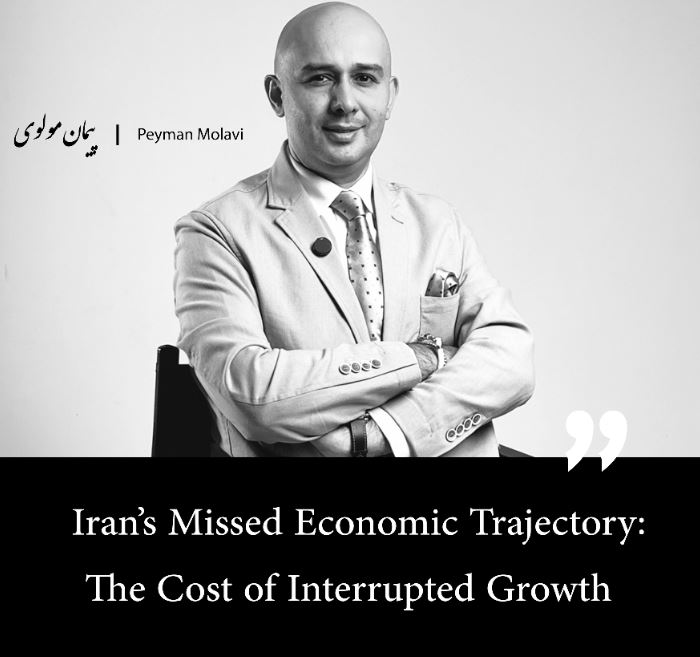
Iran’s Missed Economic Trajectory: The Cost of Interrupted Growth
Iran’s Missed Economic Trajectory: The Cost of Interrupted Growth
By Peyman Molavi
| Founder of Molavicapital Institute | Molavi Economic Research Center |
Economic history is not only about what happened, but also about what could have happened. In the case of Iran, the cost of interrupted development paths is far larger than most discussions acknowledge.
Based on my calculations, if Iran had maintained a moderate continuation of its economic growth trajectory from the 1960s to the mid-1970s (1340–1355), the country’s GDP today could realistically exceed $1.5 trillion.
This estimate is not optimistic. If anything, it is conservative.
Why this figure is defensible
During the 1960s and early 1970s, Iran was among the fastest-growing economies in the world, with real growth rates averaging 9–11% annually. However, this analysis does not assume that such exceptional growth would have continued indefinitely.
Instead, it assumes:
• A moderate long-term real growth rate of 5–6%
• A nominal dollar growth rate of 7–8%, consistent with global inflation and productivity trends
• A development path comparable to peer economies that avoided prolonged political and structural disruptions
Using standard compound growth logic, a GDP base of roughly $100 billion in the mid-1970s growing at these rates over four and a half decades leads naturally to a GDP range of $1.5–1.7 trillion today.
Iran’s true peer group
This scenario would not have made Iran an economic outlier. It would have placed the country comfortably among economies such as:
• South Korea
• Spain
• Australia
• Canada
• Upper Southern European economies
In other words, Iran’s unrealized future was not about becoming exceptional — it was about becoming normal among its historical peers.
What about income per capita?
With a GDP of $1.5 trillion and Iran’s demographic structure, per-capita income would likely be comparable to countries like Spain, South Korea, Portugal, or advanced parts of Southern Europe today.
This matters because income per capita reflects not just national wealth, but:
• Living standards
• Institutional capacity
• Social stability
• Long-term investment potential
The gap between this plausible outcome and current reality represents one of the largest opportunity costs in modern economic history.
The broader lesson
Economic development is path-dependent. Once growth trajectories are disrupted — by policy instability, isolation, or institutional erosion — the losses compound silently over decades.
Iran’s case is not about counterfactual nostalgia. It is a reminder that missed growth paths carry enormous long-term costs, and that restoring credibility, stability, and integration into the global economy is not a political luxury, but an economic necessity.
History cannot be rewritten — but it can be understood. And understanding is the first step toward better decisions.