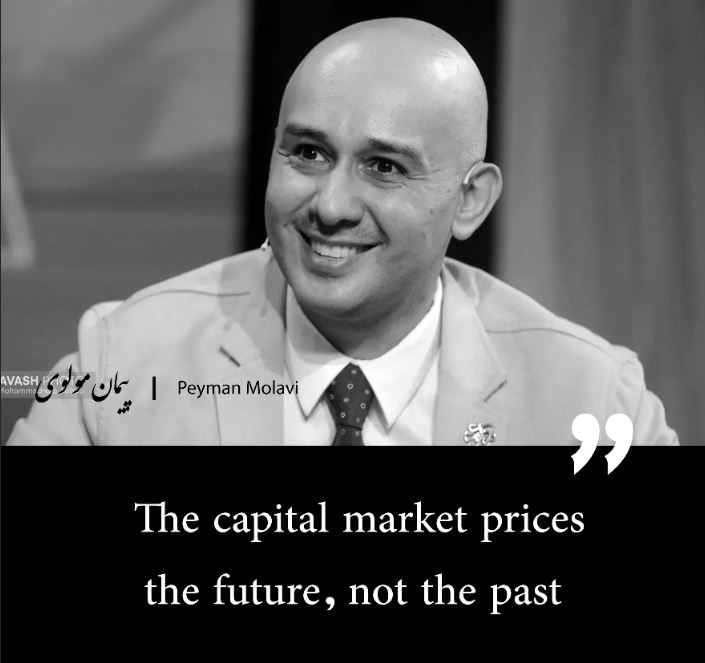
The capital market prices the future, not the past
Capital markets price the future, not the past
China’s economy is on the surface catching up with the United States, but what is visible in the deeper layers tells a completely different story; one that is more about “quality” and “sustainability” than “size.”
In terms of gross domestic product (GDP), China had reached about three-quarters of the US economy in recent years, but this ratio not only did not stabilize, but also retreated in a short space of time. This renewed divergence is a sign of an important fact: economic convergence is not necessarily linear and definite, especially when the fundamentals of growth in the two economies are of a different nature.
But a much more telling indicator is the ratio between GDP and stock market value. This is precisely where “investor perception” shows itself clearly.
In the US economy, the market value of companies is many times the annual output of the economy; In other words, each unit of economic output creates more than two units of value in the capital market. In China, by contrast, the ratio is much lower. This gap is not a temporary fluctuation, but a reflection of a deep structural difference.
Markets are pricing in the “quality of growth,” not just the “volume of growth.”
In the United States, much of the economic value is built on intangible assets: technology, brand, platform networks, and intellectual capital. These are assets that do not depreciate over time but, in many cases, grow exponentially, creating competitive advantage. Companies built on this foundation are able to generate stable and growing cash flows with high profit margins and global scalability.
In contrast, much of China’s growth has been based on heavy investments in infrastructure, real estate, and physical industries; Areas that, although they lead to increased production in the short term, face diminishing returns, capital depreciation, and debt dependence in the long term. This type of growth does not necessarily lead to the creation of sustainable value in the capital market.
So what we are seeing today is not simply a difference between two numbers; it is a gap between two models of economic development:
a model based on “physical accumulation and state guidance” versus a model based on “innovation, productivity, and investment in intangible assets.”
My conclusion as an economist is this:
The capital market prices the future, not the past. And it currently sees this future with a higher degree of certainty in the US economy than in the Chinese economy.