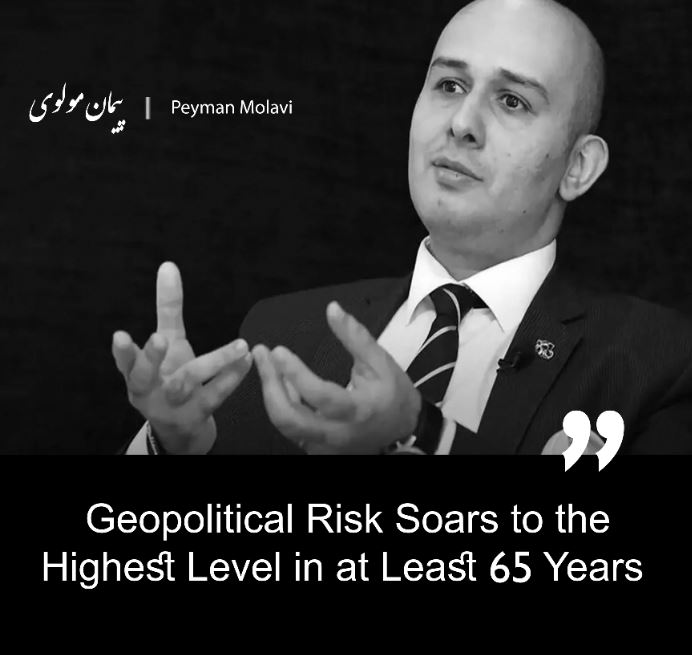
Geopolitical Risk Soars to the Highest Level in at Least 65 Years
Geopolitical Risk Soars to the Highest Level in at Least 65 Years
Peyman Molavi
Geopolitical risk has surged to its highest level in at least the last 65 years, marking a profound shift in the global economic and investment landscape. Rising tensions across multiple regions, intensifying strategic competition between major powers, expanding trade restrictions, and increasing military conflicts have combined to create an environment of exceptional uncertainty.
Unlike previous episodes that were concentrated in a single region, today’s risks are increasingly interconnected. Conflict in one part of the world can quickly disrupt global supply chains, commodity markets, shipping routes, and financial markets. Critical maritime chokepoints—including the Strait of Hormuz, the Strait of Malacca, and the Red Sea—have become central to concerns over energy security and international trade.
For financial markets, elevated geopolitical risk typically translates into higher volatility, increased demand for safe-haven assets such as gold and the U.S. dollar, wider risk premiums, and greater uncertainty over inflation and economic growth. Businesses are responding by diversifying supply chains, reducing dependence on single production hubs, and increasing investment in resilience rather than efficiency alone.
The implications extend beyond markets. Governments are prioritizing energy security, domestic manufacturing, defense spending, and strategic industries, accelerating the transition toward a more fragmented global economy. The era of globalization driven primarily by cost optimization is increasingly giving way to one shaped by security considerations and geopolitical alliances.
For investors, this new environment reinforces the importance of diversification, disciplined risk management, and long-term thinking. While geopolitical events are difficult to predict, their economic consequences can be significant and persistent. Building resilient portfolios capable of withstanding periods of elevated uncertainty has become more important than ever.
Geopolitical risk is no longer a temporary market concern—it has become one of the defining structural forces shaping the global economy in the years ahead.