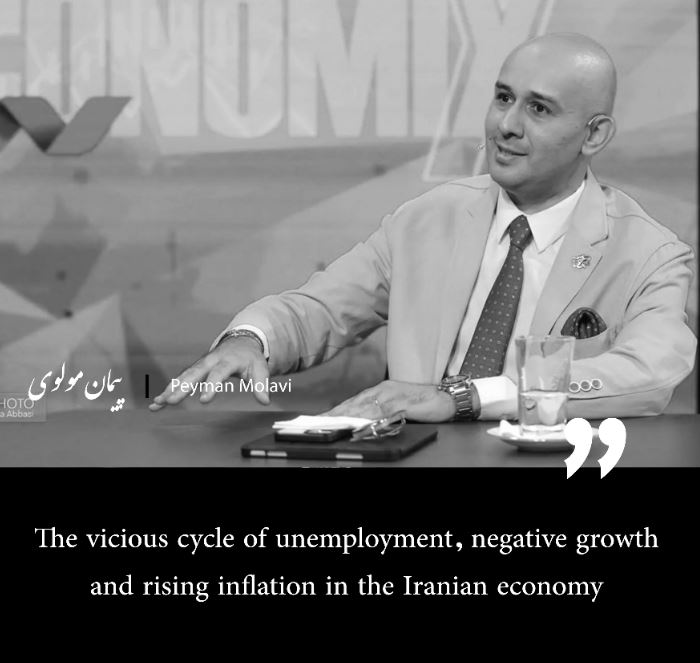
The vicious cycle of unemployment, negative growth, and rising inflation in the Iranian economy
The Vicious Cycle of Unemployment, Negative Growth, and Rising Inflation in the Iranian Economy
Peeman Molavi
Today, the Iranian economy is involved in a vicious and self-reinforcing cycle; a cycle from which unemployment, negative economic growth, and rising inflation are reproduced simultaneously and not separately, but intertwined and synergistically. Understanding this cycle is an inevitable necessity not only for analyzing the current situation, but also for designing any efficient economic policy.
At the starting point of this cycle, attention should be paid to the reduction in investment; both domestic and foreign investment. Political uncertainties, international restrictions, instability in policymaking, and the lack of a clear vision of the future have caused investors, both real and legal, to shorten their decision-making horizons. In such circumstances, capital moves towards unproductive activities, speculation, and parallel markets instead of entering productive sectors. This change in the direction of capital deals the first blow to economic growth.
The decrease in investment directly leads to a decline in the productive capacity of the economy. Firms not only do not develop, but in many cases are forced to reduce production or even close down. This situation quickly shows itself in the labor market; a decrease in demand for labor, an increase in unemployment, and, as a result, a decrease in household income. But the story does not stop there.
The decrease in household income leads to a decrease in aggregate demand in the economy. In a healthy economy, consumer demand is the engine that drives production; but in the Iranian economy, this engine has been severely weakened due to a decrease in purchasing power. The result is double pressure on firms and an intensification of the production recession. This is the same circle that stabilizes negative growth.
Meanwhile, inflation enters the field as a seemingly independent variable, but in fact deeply related to this cycle. Contrary to classical models that associate recession with deflation, the Iranian economy is in a state of “stagflationary stagnation”; a situation in which a decline in production and an increase in the general level of prices occur simultaneously. The root of this phenomenon must be sought in monetary and financial structures.
The chronic government budget deficit, which is caused by a decrease in sustainable revenues and an increase in unavoidable costs, is mainly compensated by borrowing from the banking system or by creating liquidity. This process leads to a growth in the monetary base and ultimately an increase in liquidity. But here is the key point: this liquidity is not directed towards production, but towards unproductive assets and markets. As a result, instead of creating employment, it causes prices to rise and inflation to intensify.
Rising inflation itself becomes a factor for further instability. The continuous increase in prices deprives economic actors of their ability to predict, shortens the planning horizon, and increases investment risk. In such an environment, even firms that can survive give up on development. This means returning to the starting point of the cycle: reducing investment.
But the effect of inflation is not limited to this. By reducing the real value of wages, inflation reduces the level of household welfare and deepens the income gap. In addition to its social consequences, this is also important from an economic perspective, because the reduction in welfare leads to a further reduction in effective demand and an exacerbation of the recession. In other words, inflation is not only a consequence, but also a driver in this vicious cycle.
In such circumstances, economic policymaking, if it is to be effective, cannot act in a one-dimensional manner. Tackling inflation without addressing economic growth, or attempting to create jobs without curbing inflation, will not only be ineffective, but may also exacerbate imbalances. Iran’s economy requires a comprehensive approach; one that simultaneously reforms the budget structure, controls liquidity growth, improves the business environment, and reduces macro uncertainties.
The first step in this direction is to redefine the role of the government in the economy. The government must transform from an interventionist and costly actor into a smart regulator and facilitator. Reducing the budget deficit, improving fiscal transparency, and establishing monetary discipline are prerequisites for curbing inflation. In addition, establishing stability in policymaking and improving international economic relations can pave the way for capital inflows and restoring economic growth.
Finally, it must be acknowledged that the cycle of unemployment, negative growth, and inflation is not a temporary phenomenon, but rather the result of years of accumulating imbalances. Breaking out of this cycle also requires tough decisions, structural reforms, and most importantly, the political will to change. Without these components, Iran's economy will remain in this vicious circle, where each variable pushes the other towards further deterioration.