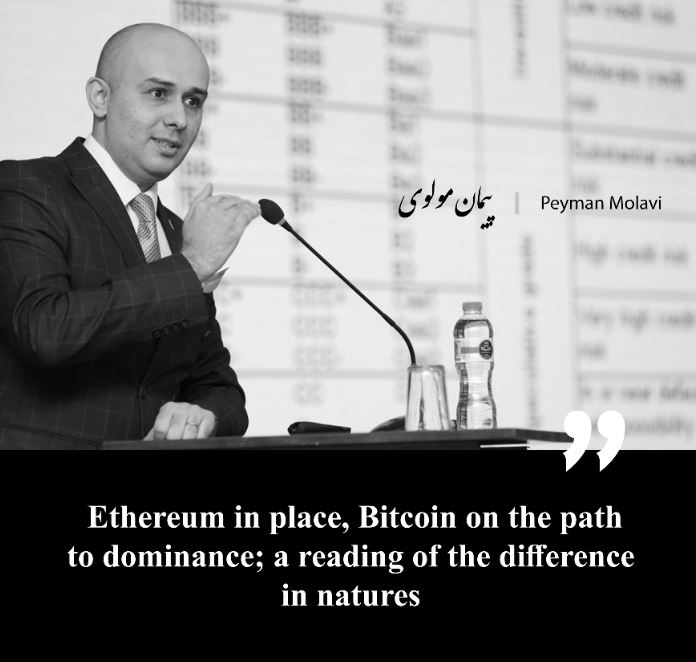
Ethereum in place, Bitcoin on the path to dominance; a reading of the difference in natures
Ethereum at a standstill, Bitcoin on the path to dominance; a reading of the difference in natures
Payman Molavi | Wealth Manager
The fact that Ethereum’s price is still fluctuating around its previous levels after a few years, while Bitcoin has conquered new price paths, is not a random anomaly in the market; it is a reflection of the profound difference in the “economic identity” of the two assets. The market, ultimately, responds not simply to technology but to narrative, certainty, and portfolio placement; and it is precisely at this point that the gap between these two giants of the cryptocurrency world becomes apparent.
Ethereum, at its core, is a platform; an infrastructure for running smart contracts, decentralized applications, and innovations that are still being formed. Its value is directly tied to the extent of use of this ecosystem; to the boom of DeFi, to the return or decline of NFTs, to the success or failure of second layers. In other words, Ethereum is involved in the future; A future that has not yet been fully realized, and this increases its inherent uncertainty. Any wave of innovation can jump the price, and any decline in excitement can drag it into stagnation. Therefore, Ethereum’s price behavior is more like a technology asset with the nature of a venture capital investment than a classic store of value asset.
Bitcoin, in contrast, is fundamentally far from such complexity. Bitcoin does not seek to host applications, nor does it require the success of peripheral ecosystems to justify its value. Its narrative is simple, transparent, and remarkably powerful: “digital gold.” In a world faced with chronic inflation, rising debt, and monetary policy instability, an asset with a limited supply, a predetermined issuance schedule, and an immutable structure becomes a natural destination for large capital. This simplicity is not a weakness, but rather a strategic advantage of Bitcoin.
From a wealth management perspective, institutional capital is looking for assets that can be easily fitted into classical analytical frameworks; assets with modelable risk, high liquidity, and a stable narrative. Bitcoin has established itself as a “macro asset” alongside gold, and even to some extent competing with it, in recent years. The arrival of new financial instruments, increasing institutional acceptance, and the growth of trading infrastructure have all reinforced this position. In such an environment, Bitcoin is seen not only as a digital asset, but also as part of a new architecture for the global store of value.
On the other hand, despite significant technical advances—including the move to proof-of-stake and efforts to improve scalability—Ethereum still faces a fundamental challenge: ambiguity in the identity of the investment. Is Ethereum an anti-inflationary asset? A fuel for the digital ecosystem? Or the equity equivalent of a decentralized platform? This ambiguity makes the macro investor approach it with more caution. Even if Ethereum is more complex and advanced from a technological perspective, the market does not necessarily reward complexity; it rewards certainty.
Another difference lies in the monetary policy of the two assets. Bitcoin, with its fixed and immutable supply cap, offers a highly predictable framework; while Ethereum, despite its anti-inflationary tendencies at times, still lacks a hard and immutable supply cap. This difference is simply not to be ignored when investors are looking for a safe haven from macro volatility.
Ultimately, it must be acknowledged that these two assets are playing on two different playing fields. Bitcoin is winning the “trust” game, a game whose rules are simple but whose consequences are profound. Ethereum, on the other hand, is playing the “innovation” game, a game with high potential but uncertainty. For this reason, in periods when macro risks increase and capital seeks safety, Bitcoin has the upper hand; and in periods when the appetite for risk and innovation increases, Ethereum can shine.
But if the criterion is the preservation and accumulation of wealth over the long term and in the face of global uncertainties, the dominant market choice—at least for now—is clear: Bitcoin has managed to gain a position of superiority over Ethereum through simplicity, scarcity, and wider adoption, a position that has been achieved not through complexity, but through clarity.