The G7’s Shrinking Share of the World — and Its Expanding Influence
The G7’s Shrinking Share of the World — and Its Expanding Influence
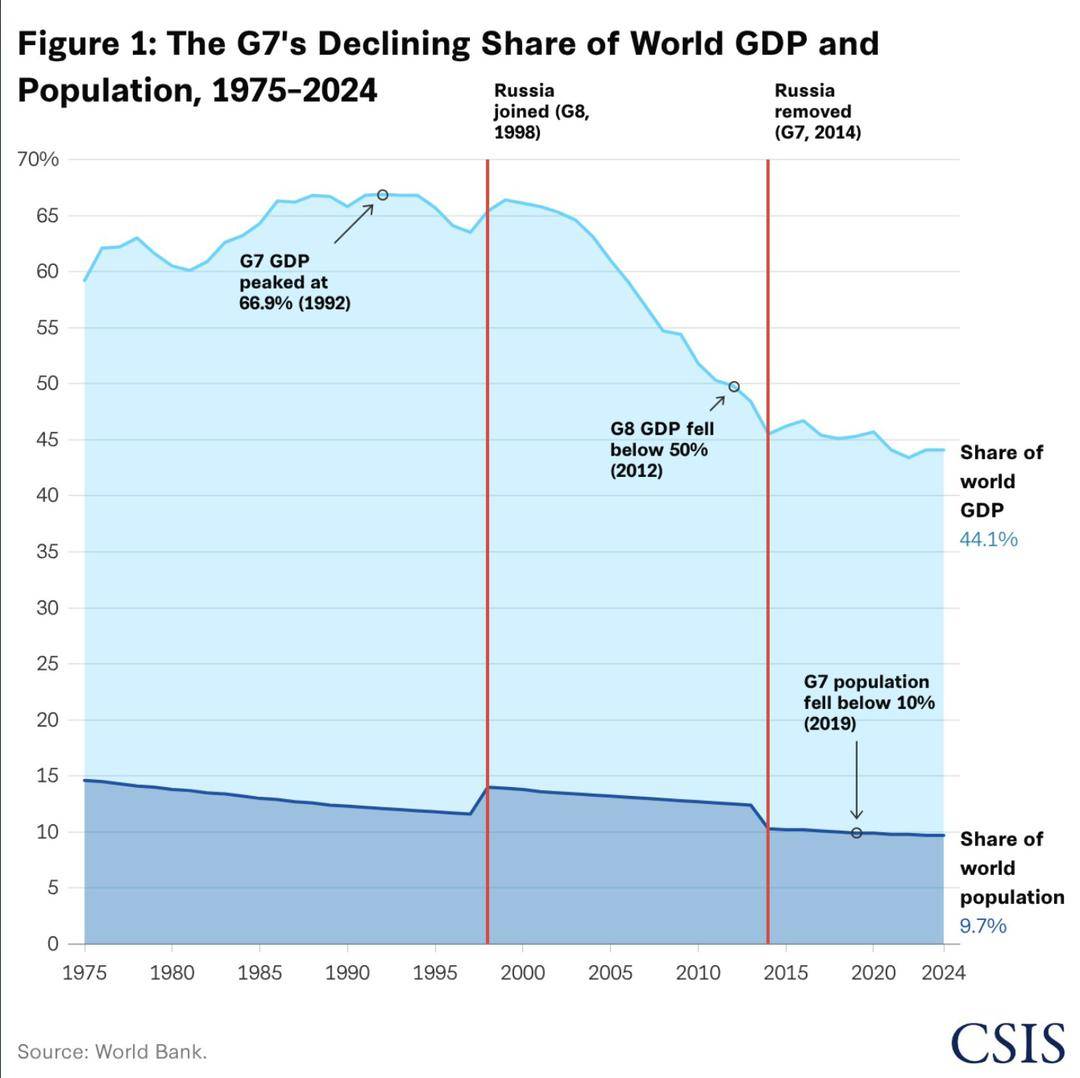
Peyman Molavi | Economist In 1980, the G7 economies accounted for 60.5% of global GDP while representing 13.8% of the world’s population.
Today, those figures have fallen to 44.1% of global GDP and just 9.6% of the world’s population.
At first glance, this appears to be a story of decline.
But the more interesting story is that while the G7’s share of the world economy has shrunk, its agenda has become increasingly global.
Over the past four decades, emerging economies have grown dramatically. China, India, Southeast Asia, and parts of Latin America have expanded their economic footprint, reducing the relative weight of traditional Western powers.
Yet when the world discusses financial regulation, sanctions, technology standards, climate policy, reserve currencies, international banking, sovereign debt, or global security, the decisions and priorities of the G7 still shape outcomes far beyond its borders.
This creates an important paradox.
Economic power is becoming more distributed, but institutional power remains concentrated.
The institutions that govern global finance and trade were largely built during a period when G7 economies dominated the world. As a result, influence often extends far beyond what GDP statistics alone would suggest.
For investors and wealth managers, this distinction matters.
Markets are increasingly driven by a multipolar economic reality, but capital flows continue to be heavily influenced by policies originating from Washington, London, Tokyo, Ottawa, Paris, Berlin, and Rome.
Understanding the future requires recognizing both trends simultaneously:
• The world economy is becoming less concentrated.
• Global governance remains highly concentrated.
The key question for the next decade is whether institutional influence will gradually follow economic reality—or whether established powers will continue to shape global rules despite representing a shrinking share of global output and population.
The answer will determine not only the future of geopolitics, but also the direction of capital, investment opportunities, and wealth creation worldwide.